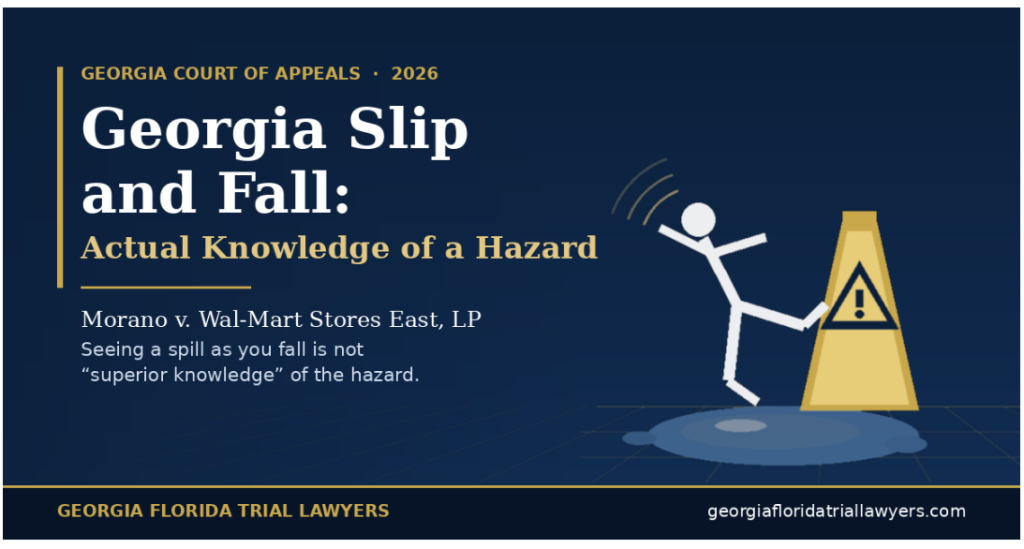
In a Georgia slip and fall case, what the injured person knew about the hazard, and exactly when they knew it, can decide whether the case ever reaches a jury. A June 2026 decision from the Court of Appeals of Georgia involving a spill at a Wal-Mart store draws an important line. Spotting a hazard in the split second before you fall is not the same as knowingly walking into it.
Actual Knowledge of a Hazard
Morano v. Wal-Mart Stores East LP, A26A0191
Plaintiff slipped in spilled substance and she tried to warn another customer of the spill, but she warned the customer as she was in the act of slipping. She discovered and saw the substance on the floor AFTER she stepped in it. “Knowledge of a hazard gained after the invitee has already been exposed to it but immediately before the invitee falls does not satisfy the requirement articulated in Robinson that the plaintiff must have “intentionally and unreasonably exposed herself to a hazard of which she knew.” The record did not contain plain, palpable, and undisputed evidence that the plaintiff intentionally and unreasonably exposed herself to the hazard after becoming aware of it. This presents a question of fact for the jury as to whether the plaintiff had equal or superior knowledge of the hazard.
Why This Georgia Slip and Fall Ruling Matters
Stores and their insurers often defend injury claims by arguing that the customer knew about the danger as well as, or better than, the business did. Under Georgia’s premises liability statute, O.C.G.A. § 51-3-1, owners must use ordinary care to keep their premises safe for invited customers. However, under the Supreme Court of Georgia’s decision in Robinson v. Kroger Co., 268 Ga. 735 (1997), a property owner can still win if the injured person had equal or superior knowledge of the hazard.
In Morano, the trial court granted summary judgment to Wal-Mart, which would have ended the case before trial. The Court of Appeals reversed. Store video showed the shopper in the aisle before her fall. Yet it did not clearly show her feet or the substance on the floor. That left real questions about what she saw and when, and those questions belong to a jury, not a judge. You can read the full Court of Appeals opinion for the court’s complete analysis.
Key Takeaways for Injured Shoppers
- Noticing a spill while you are already slipping does not automatically bar your claim.
- The store must prove you knowingly and unreasonably exposed yourself to the danger.
- Surveillance video can help or hurt a case, and stores may overwrite it quickly.
- When the facts are disputed, a jury should decide who knew what.
What to Do After a Georgia Slip and Fall
The steps you take right after a Georgia slip and fall can protect your claim. Report the fall to a manager and ask for a copy of the incident report. Photograph the substance, the area, your shoes, and any missing warning signs. Get the names and phone numbers of witnesses. See a doctor promptly, even if you feel fine. Avoid giving a recorded statement to the store’s insurer before you get legal advice.
Timing matters. In Georgia, the statute of limitations for most personal injury claims is two years under O.C.G.A. § 9-3-33. An experienced slip and fall injury attorney can send a preservation letter so the store keeps its video and records before they disappear.
Talk to an Attorney About Your Fall
If you were hurt in a Georgia slip and fall, the store will likely argue that you should have seen the hazard. Rulings like this one show that argument has limits. Drew Gilliland personally reviews every case and can help you understand your rights. Schedule a free consultation or call (407) 718-2128 today.
This article is for general information only and is not legal advice. Reading it does not create an attorney-client relationship.