
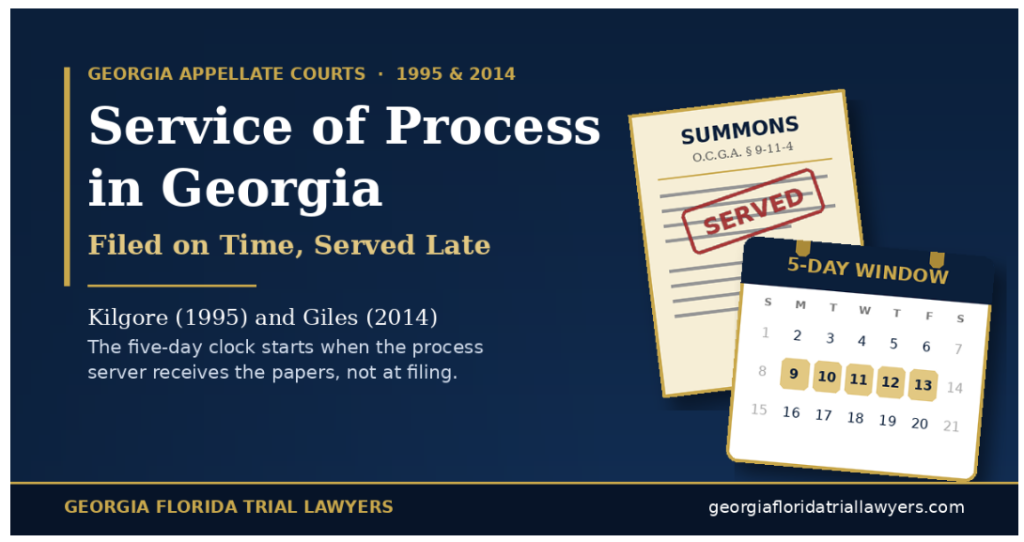
Most people assume that if a lawsuit is filed before the statute of limitations runs, the case is safe. In Georgia, filing is only half the job. The defendant also has to be served, and when service happens after the limitations period has expired, the case can be thrown out unless the service “relates back” to the date the complaint was filed.
Two decisions do most of the work in explaining when that happens. In Georgia Farm Bureau Mutual Insurance Co. v. Kilgore, 265 Ga. 836, 462 S.E.2d 713 (1995), the Supreme Court of Georgia held that the five-day service rule in our Civil Practice Act is a deadline for the process server, not the plaintiff. Nearly twenty years later, in Giles v. State Farm Mutual Insurance Co., 330 Ga. App. 314, 765 S.E.2d 413 (2014), the full Court of Appeals built on Kilgore to settle exactly when that five-day clock starts, and in doing so overruled dozens of its own earlier decisions. Both cases arose from uninsured motorist claims, but the rules they announce apply to every civil lawsuit filed in Georgia.
The Starting Point: Relation Back and the Five-Day Rule
A civil action in Georgia is commenced by filing a complaint. The complaint must be filed within the limitations period, but it can be served after that period runs. For more than fifty years, Georgia courts have followed the rule that if a timely filing is followed by timely service, perfected as the law requires, the service relates back to the filing date, even if the statute of limitations expired in between.
The question is what counts as “timely service.” The answer begins with O.C.G.A. § 9-11-4(c), which says that when service is made in Georgia, the person making service shall make it within five days from the time of receiving the summons and complaint, but that failure to serve within five days will not invalidate a later service. Kilgore and Giles explain what that sentence means.
Kilgore: The Five Days Belong to the Process Server
On May 31, 1990, Delana Kilgore was driving a car owned by Fred Kilgore when a tractor struck it. In February 1991, in a lawsuit that was already pending, the Kilgores filed a cross-claim against the tractor’s owner and operator for property damage and personal injuries. Later, it was determined that the owner and operator were uninsured. Under Georgia’s uninsured motorist statute, that meant the Kilgores had to serve their own carrier, Georgia Farm Bureau, as though it were a named defendant, within the time allowed for valid service on the at-fault parties.
On May 15, 1992, about 15 months after filing the cross-claim, the Kilgores asked the sheriff to serve Georgia Farm Bureau. The two-year limitations period for the injury claim ran on May 31, 1992. The sheriff could not complete service until June 2, 1992, two days late, because Georgia Farm Bureau’s registered agent was out of the country. The insurer moved to dismiss.
The Supreme Court affirmed the denial of that motion. The property damage claim was easy, because it was served well within the four-year limitations period for property damage. The injury claim, served after the two-year period, turned on the plaintiffs’ diligence.
The key holding was the Court’s reading of § 9-11-4(c). The statute, the Court said, provides a time frame for performance by the process server once service is sought, but does not provide a time limit within which the plaintiff must start the service process. So the mere passage of time between filing and service is not, by itself, a valid reason to dismiss. The focus is on what the plaintiff did after learning that the process server had not served within the statutory time frame. The Court also noted that on May 15, 1992, the Kilgores could still have dismissed and refiled under Georgia’s renewal statute, so the insurer was not prejudiced by measuring timeliness from that date.
On the facts, the trial court was entitled to find the Kilgores diligent. They gave the sheriff the papers before the deadline, followed up to see whether service had been made, and asked that it be expedited. The delay came from the unavailability of the insurer’s own registered agent.
Presiding Justice Fletcher, joined by Justice Sears, agreed with the outcome but not the reasoning. In their view, diligence should be measured from the date the complaint is filed, and the majority’s rule relieves plaintiffs of the responsibility to start service promptly.
Giles: When the Five-Day Clock Starts
Giles also began with a car crash. On June 3, 2005, James Giles was hit by the driver of a stolen vehicle. He sued the unknown driver in Fulton County on May 30, 2007, and served his uninsured motorist carrier, State Farm, through its registered agent in Cobb County. In November 2011, he voluntarily dismissed the case.
On Monday, April 30, 2012, Giles refiled under Georgia’s renewal statute, which allows a dismissed case to be refiled within six months. The clerk issued a summons that day. The Cobb County Sheriff’s Office received the papers on May 7, 2012, the last day of the six-month renewal period, and served State Farm two days later, on May 9.
State Farm moved to dismiss, arguing that service came after both the limitations period and the renewal period. The trial court agreed. It ruled that “the person making such service” in § 9-11-4(c) means the plaintiff, with the sheriff acting merely as the plaintiff’s agent, so the five-day clock started when the complaint was filed. Because service came more than five days after filing, and Giles offered no explanation for the week it took the papers to reach the sheriff, the court found he had not been diligent and dismissed the case.
The Court of Appeals, sitting as a full court in an opinion by Judge Boggs, unanimously reversed. It made two holdings.
First, the plaintiff is not “the person making such service.” Relying on Kilgore, the court pointed out that Georgia’s process statutes put the responsibility on the clerk, not the plaintiff, to issue the summons and deliver it for service, including forwarding papers to the sheriff of another county when the defendant lives there. The plaintiff cannot be blamed for the time the papers spend in the clerk’s hands.
Second, the five days run from the time the person making service receives the summons and complaint, not from the filing date. If the legislature had wanted the clock to start at filing, the court said, it could have written the statute that way. And because the period is less than seven days, weekends and holidays are not counted.
From there, the court restated the general rule. If service is made within the five-day grace period, it relates back to the filing date as a matter of law. If service comes after both the limitations period and the five-day window, relation back depends on the plaintiff’s diligence, and the plaintiff bears the burden of showing it was not at fault.
The court acknowledged that, over the years, it had paraphrased the rule in ways that quietly changed it, saying that service had to be made within five days of filing. To clean up the law, it expressly overruled Bible v. Hughes, Bowman v. United States Life Insurance Co., Parker v. Shreve, and every other decision listed in its footnotes, more than sixty cases in all, to the extent they misstated how the five-day period is calculated.
Applying the correct rule was simple. A renewal action is a new action, so the filing and service requirements must be met again, and the five-day grace period applies. The sheriff received Giles’s papers on May 7 and served State Farm on May 9, inside the five-day window. The service related back as a matter of law, and the dismissal was reversed.
How the Rules Fit Together
Read together, Kilgore and Giles give Georgia a clear framework for deciding whether late service saves a case.
First, if the defendant is served before the statute of limitations runs, timing is not an issue.
Second, if service comes after the limitations period but within five days of when the sheriff or process server received the summons and complaint, not counting weekends and holidays, the service relates back to the filing date automatically. No showing of diligence is required.
Third, if service comes after both the limitations period and that five-day window, the case survives only if the plaintiff proves diligence. Under Kilgore, the delay in starting service does not decide the question by itself, and the court looks closely at what the plaintiff did once it became clear that service had not been made. Georgia courts also expect a heightened level of diligence once a plaintiff is on notice of a service problem, so a failed attempt or a bad address calls for immediate action.
The two cases also teach the same lesson about uninsured motorist claims. In both, the injured person’s own insurer tried to escape coverage on a service technicality. Georgia law requires the UM carrier to be served within the same limitations period that applies to the uninsured driver, and that requirement can be satisfied by timely service in a renewal action.
Practical Lessons
Get the papers moving the day you file. Kilgore and Giles protect plaintiffs from delays caused by clerks, sheriffs, and registered agents, but not from their own delay. The Fletcher concurrence in Kilgore shows how skeptical some judges are of a plaintiff who waits. The safest course is to make sure the summons and complaint go out for service immediately.
Know who has the papers and when they got them. Under Giles, the five-day window runs from receipt by the person making service. The sheriff’s file stamp or entry of service, or a private process server’s records, can be the evidence that saves a case filed near the deadline.
Count the days correctly. Weekends and holidays do not count toward the five-day period. In a case filed on the eve of the deadline, that difference can decide whether service relates back automatically or whether the plaintiff must prove diligence.
Follow up, and keep a record. In Kilgore, the plaintiffs won because they could show they checked on service and pushed to have it expedited. Calls, emails, and returns of service are the evidence that wins or loses a diligence fight.
Treat a renewal action as a brand-new case. A refiled case must be served again, including service on the uninsured motorist carrier. Giles shows that a renewal filed near the end of the six-month window can still be saved, but only if service follows promptly.
A Georgia Service of Process Checklist
Kilgore and Giles both turn on the details of service of process, and most service of process problems can be prevented with planning. Before and after filing, confirm each of the following:
- Who will handle service of process: the sheriff in the defendant’s county or a private process server, and how the clerk will get the papers to them.
- The exact date the sheriff or process server received the summons and complaint, because under Giles the five-day window starts then.
- Every party that must be served, including your own uninsured motorist carrier.
- A record of every follow-up call, email, and return of service, in case diligence is ever challenged.
You can read the full Court of Appeals opinion in Giles v. State Farm Mutual Insurance Co. to see the court’s complete analysis and the list of overruled cases. Procedural rules like these come up throughout Georgia injury cases; our post on Georgia’s offer of settlement statute covers another one that can shift thousands of dollars in attorney fees. If your filing deadline is close, contact our office so service of process is handled correctly from day one.
Talk to a Lawyer Before the Clock Runs
Service of process sounds like a technicality, but it decides real cases, and insurance companies use it to avoid paying claims. If you or a family member has been hurt in Georgia or Florida, the lawyers at Georgia Florida Trial Lawyers can make sure your case is filed and served correctly and on time, so your right to recover is protected from the start.
Contact us for a free consultation.
This article is for general informational purposes only and is not legal advice. Reading it does not create an attorney-client relationship. Georgia’s service of process rules continue to be shaped by new appellate decisions, and every case turns on its own facts. Consult a licensed attorney about your situation.